Who is it for · Fintechs & Neobanks
Launch fast
without buying your next dependency
Neobanks and fintechs move quickly until their platform vendor becomes the most restrictive part of the business. Or they build alone before realising it’s taking too long to build essential, common capabilities.
Plumery gives you a third option: AI-ready banking journeys and developer-first tools, so a lean team can launch sooner and keep building on its own terms.
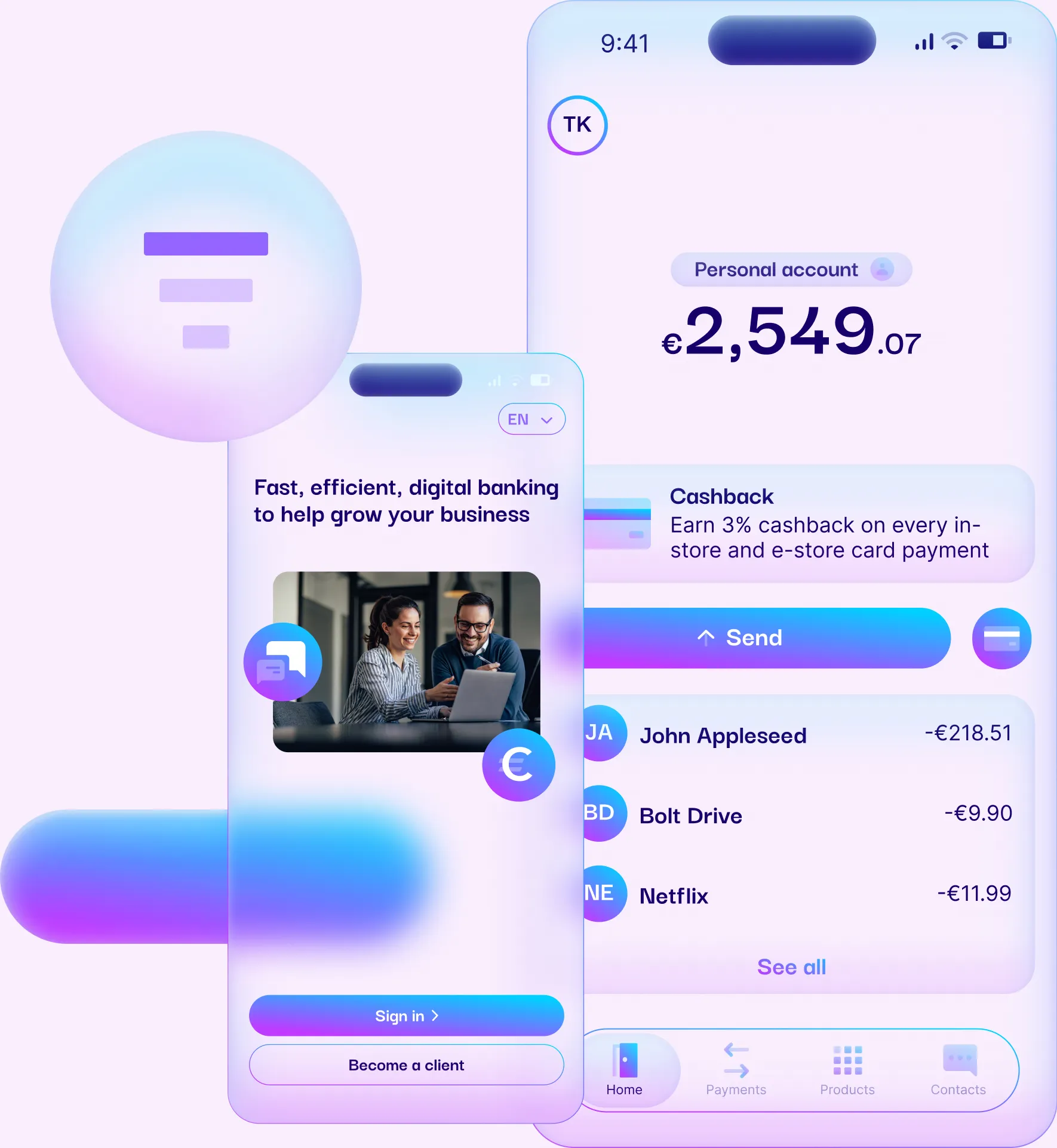
The digital banking platform fintechs & neobanks need
Shorten the route to market without shortening the life of your vision
Many fintech platforms offer an attractive shortcut: use their capabilities and accept their product model’s predefined customisation options. It works quickly, until you need to do something the platform was not designed for. Then your roadmap becomes a queue of change requests and compromises. Plumery gives fintechs and neobanks a faster starting point without taking away the independence they will need later.


Launch without building table stakes
Start with proven onboarding, accounts, payments, cards, lending and money-management journeys instead of spending your first development cycles recreating standard banking services.

Build what you need with a leaner team
Build and integrate fast by giving developers a developer-first foundation and templates, and bring your own harness, such as Claude Codex, for our SDLC, which is hardened on banking best practice and compliance requirements.

Control the full customer experience
Control the front end and back end of the platform with no black boxes in sight, so developers and AI can take full advantage of it. Digital journeys and integrations are yours to adapt and build out how you see fit.

Change direction at lower cost and greater speed
Move into a new market, add a product or replace a partner without touching your core or waiting on a change order. Plumery is open by design, so the platform can evolve as quickly as your strategy.
Fintechs neobanks overview of capabilities
Build a product the financial industry hasn’t seen yet
Customers won’t choose a neobank or fintech’s product because its team successfully assembled core banking services, identity checks, payment service providers and account ledgers. With Plumery, you can quickly get the financial product capabilities customers already expect, then use your time and developers to build differentiation.

An AI-ready foundation for a future market
With our open foundation, you can quickly introduce AI as another channel for the platform’s digital journeys, offering customer support, personalisation, financial guidance and executing tasks. Via MCP, you can connect the models of your choice.

Digital payments and cards
Offer digital wallets, debit cards, recurring payments, and the ability to transfer funds. You can choose from our prebuilt connectors and connect your preferred payment service providers to the platform rather than being restricted by a vendor’s ecosystem.

Automated & personalised lending
Launch lending services with explainable AI loan origination, as well as conversational AI to handle loan enquiries. Offer personalised terms across consumer lending, supply chain finance, credit lines, BNPL and mortgages.

Digital bank accounts
Launch current, checking or savings accounts with digital onboarding, account management, direct deposits, real-time transaction views, statements and notifications. Adapt the journeys to your customer segments without rebuilding any foundations.

SME financial services
Serve small and medium enterprises with onboarding, accounts, cards, lending, payments, team permissions and accounting integrations.

Personal finance and financial health
Offer out-of-the-box budgeting and savings tools, and develop your own features to improve users’ financial literacy around personal loans and goal setting, and help people build towards financial stability.
FAQ
Questions that may be on your mind.
If you can’t find the answers you’re looking for, speak with our growth team or solution architects.
What is a digital banking platform for fintechs and neobanks?
A digital banking platform lets fintechs and neobanks build and run online, mobile, and agentic banking services on pre-built infrastructure, rather than building from scratch.
Since their inception, digital banking platforms have enabled organisations such as banks, fintechs and credit unions to offer online banking and later mobile banking services to their customers or members. For some financial institutions this eliminated the need for physical branches. Digital only banks are now commonplace, and the global neobank market is set to overtake physical banks. In 2026, McKinsey noted that Nubank and Revolut surpassed traditional banks in their region, based on valuation and profitability.
Originally, digital capabilities would either be built custom in-house or through large enterprise platforms, requiring big scale digital transformation. These legacy systems have largely been superseded by SaaS platforms, which made the same feature set available more affordably – and faster – for a wider range of organisations through the cloud. The drawback is their customisation options are limited.
In 2026, the industry is shifting again, and there is a possibility for digital banking platforms to live up to their name as platforms. The market has a real need for the same convenience and lower-price that SaaS offers, but also for independence – the capability to build freely on a platform, without vendor lock-in. This makes not only table-stakes digital banking accessible, but differentiation too.
How quickly can a fintech launch banking services?
The timeline can be less than three months with Plumery’s platform.
We reduce the work required by providing common banking journeys, app foundations and integrations from the outset. This means the team does not need to design and develop every standard capability - onboarding, bank accounts, payments, cards, savings, lending, money management and customer support, etc - before testing the proposition with customers.
How can a fintech launch with fewer developers?
The main opportunity is to stop asking developers to recreate standard banking functionality, and offer your developers access to Plumery’s already-acquired knowledge so they can build at speed.
Plumery supplies reusable digital journeys, user-interface templates, and developer tooling for building new services and integrations. This lets a smaller team spend more time on differentiated products for their customers and maintain control of the finished product.
Plumery provides production-ready digital journeys, user interface templates and developer tooling that remove much of the work involved in creating standard banking experiences. Instead of spending months building parity features, your developers can focus on the products and experiences that make your business different.
That means a smaller team can launch sooner, continue to ship quickly as the business grows, and stay in control of the platform they build.
What key features do the best digital banking platforms include?
A digital banking platform should offer all the table-stakes capabilities you would expect to see: accounts management, lending, onboarding, identity and access management such as multi-factor authentication, payments, deposits, real-time notifications, and UI/UX templates to create mobile apps and online banking. And it enables compliance with regulatory standards.
The exact capabilities will depend on whether you’re focusing on retail or SME banking, whether you’re a credit union, bank or fintech.
We’d argue that the top digital platforms should also leave you free to build: new digital journeys, integration into any core and any software, implemented in-house or by your choice of partner. The platform should take digital banking in any direction you want, not just theirs.
How is Plumery different from a banking-as-a-service provider?
Banking-as-a-service providers often combine regulated infrastructure, accounts, payments and compliance services behind a single commercial relationship. This can simplify launch for a neobank but may also tie it to one provider’s product range, geographic coverage and technical model.
Plumery operates as the digital experience and orchestration layer, which can also work with a banking-as-a-service offering. Plumery connects to your choice of cores, regulated institutions, payment providers and other integrations while leaving you free to replace those components.
A fintech may use Plumery alongside a banking-as-a-service provider or partner bank without making that provider the permanent owner of the customer experience.
Can the platform support multiple countries and currencies?
Yes. Plumery can support multi-currency accounts, international money transfers and market-specific customer journeys.
A fintech firm can connect different providers and adapt onboarding, payments, disclosures and compliance processes for each jurisdiction. This makes it possible to reuse the platform while respecting the differences between regulatory environments.
Can I use my own AI model/agent or is Plumery building its own closed ‘castle’?
Our platform is MCP-compatible, so you’ll always be able to use any model or agent – even the ones that aren’t yet on the market. Another key benefit is you won’t have to overhaul your underlying system to use a new agent.
Can fintechs connect their own payment service providers?
Yes. Plumery is designed for an open ecosystem.
You can connect preferred payment service providers, card processors, transfer services, digital-wallet infrastructure and foreign-exchange partners. If the commercial or technical relationship changes, the provider can be replaced without rebuilding the full customer experience.
How does Plumery use customer data?
Plumery helps fintechs and neobanks to connect customer data to digital journeys, as well as AI-models via MCP. Our platform provides the means to create relevant personalisation and support for customers while respecting privacy and regulatory concerns, and our platform is SOC2 and ISO 27001 certified.
How does Plumery support artificial intelligence and machine learning?
Plumery provides an open foundation for connecting artificial intelligence and machine-learning to development, support, personalisation, fraud, decisioning and other workflows. The benefit of an open approach is that it’s not restricted to one model or a set of predefined use cases. Your use of AI can change as the technology and regulatory environment develop.
You can read more on AI-ready banking here.
Can the platform support digital assets or distributed ledger technology?
Yes. You can introduce new products, including digital-asset services or distributed-ledger technology, without forcing them into an architecture that predates the use case.
How can the platform support our financial inclusion goals?
Many fintech and neobanks set out to expand access to financial services for unbanked and underbanked consumers, freelancers, migrants or small businesses overlooked by traditional banks. But the limits of financial technology can determine the extent to which a firm can fulfil its vision.
Plumery lets fintechs and neobanks operate without vendor dependency, so they can design onboarding, payments, savings, credit and money-management journeys around specific customer needs. That may include clearer eligibility decisions, alternative information for assessing risk, multilingual support, budgeting tools and spending habit insights to support financial decisions, or products designed around irregular income.
With a safe foundation for total freedom, fintechs and neobanks have room to build beyond what traditional financial institutions have already created, so everyone can access financial services.
What other financial institutions will benefit from a digital banking platform?
Neobanks, fintechs and credit unions will all use digital banking platforms to launch and run digital services without building from scratch. The trade-off to watch: some platforms cap what you can change without vendor involvement, so check the flexibility your roadmap needs before prioritising cost savings above all else.
How compatible is the platform with other neobank partners?
Agnostic at every layer, our platform can be connected to your preferred core, sponsor or partner bank, identity provider, card processor, payment provider, CRM and data services. You’re free to replace individual components without overhauling the whole digital experience. So unlike traditional banks performing grand and slow digital transformations every few years, you can make switches fast.
How should fintech companies choose a digital banking platform?
Look beyond the launch demonstration and ask:
- Who controls the product roadmap after launch?
- Can our own developers change the customer journeys?
- Can we choose and replace cores, banks and payment providers?
- What happens when we enter another country or add another product?
- How much work depends on vendor professional services?
- Will the platform still suit us after product-market fit?
- Can a small team operate and extend it efficiently?
- Do we retain ownership of what makes the proposition different?

Launch fast without buying your next dependency
Get back to speed.